Sustainability and the Circular Economy
As we know, being mindful of our carbon footprint is more important than ever. To do this, we need to consider the full life cycle of the product, all the way from raw materials to manufacture to end-of-life. We all need to reduce waste as much as possible.
The longer the product’s life, the less we throw away and the less waste we generate. Thanks to our product design, our luminaries use the most current and efficient LEDs. In addition, they can be repaired and upgraded to accommodate the latest innovations as they arrive, allowing our luminaries to be used for decades.
Here at Light Projects, we are taking steps to enable our customers to accurately calculate the impact on the environment when specifying our products. We do this with the aid of both the TM65 and TM66 standards.
What is TM65
TM65 is a CISBE (Chartered Institution of Building Services Engineers) publication that provides a high level methodology to calculate the embodied carbon in a product or service through its life cycle.
When no Environmental Product Declaration (EPD) is available, TM65 provides engineers with a alternative or supplementary tool.
What is the Circular Economy?
The circular economy is a model of production and consumption, which involves sharing, leasing, reusing, repairing, refurbishing and recycling existing materials and products as long as possible. In this way, the life cycle of products is extended.
The principles of the Circular Economy, its drivers and barriers are explained in CIBSE TM66
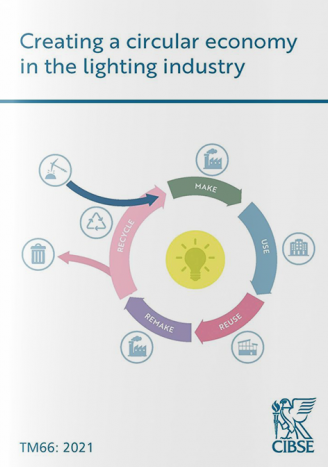
What is TM66?
CIBSE TM66 or specifically TM66 Circular Economy Assessment Method (CEAM)-Make is a algorithm that looks at various aspect of design and manufacture to provide a numeric assessment of a product’s economic sustainability and compliance with circular economy principles.
The new algorithm is the result of a cross-industry collaboration and a willingness to provide practical guidance and tools to help develop a circular, sustainable approach to lighting and building services engineering more broadly.
Although still in beta stage, through CEAM-Make, a complex subject can be translated into a comprehensible star rating, giving manufacturers and specifiers targeted, useable and independent metrics to compare products and strive for the best-suited product.
Why is it important?
The hope is that specifiers will choose products that have been designed to be reusable and upgraded rather than simply disposing of them. Circularity is not a new concept but is increasingly important with the environmental challenges the world faces.
It is not mandatory for manufacturers to use the TM66 model to assess their products but at Light Projects we are starting this journey with our newest product, the LEDStar XL, being put through this process.
With manufacturers able to enter relevant data to obtain a rating, this is a good starting point and means over time the product can be further adapted by design and updated to continually improve.
Light Projects is committed to the circular economy and proud of the products we have designed over the years. We have been involved in various projects where clients have wanted to upgrade from halogen to LED light sources, and TM65/TM66 is the next natural step for us and one we’re excited to be taking.